

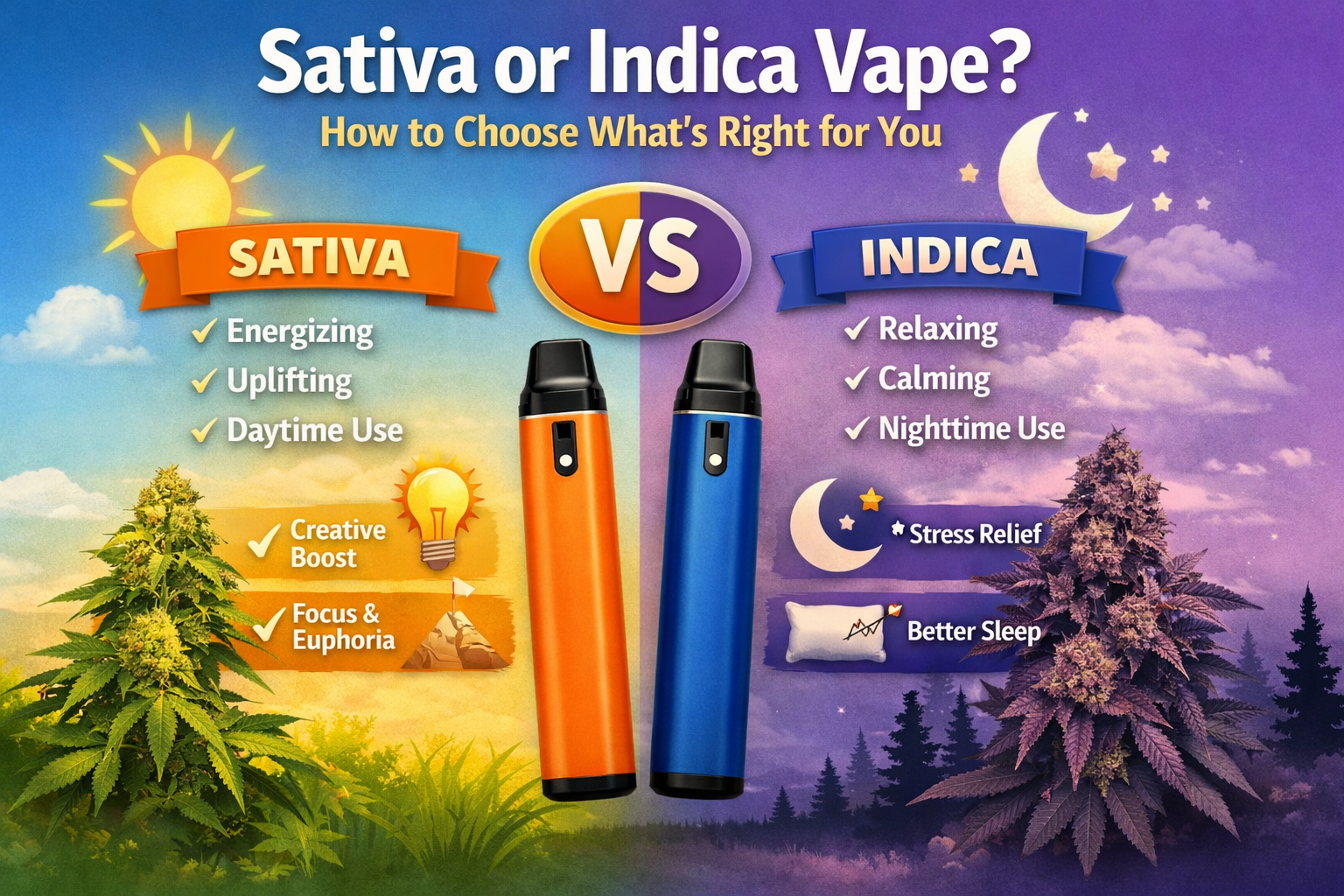
When you first start scrolling through vape menus, it kind of feels like stepping into a whole new world you did not exactly sign up to study for, right? Just think about it, there’s strain names that sound like band titles, percentages everywhere, flavor descriptions that read like a dessert menu, and then this big split between “sativa” and “indica” that everybody seems to treat like it is obvious.
If you are just a health-conscious adult trying to find a natural way to relax, handle stress, or unwind in a calmer way, that can go from interesting to overwhelming pretty quickly. And if you’re trying to unwind, then shouldn’t the research itself not be stressful either?
So now obviously here, instead of guessing based on a couple of buzzwords, it helps to slow everything down and slowly try and figure out the differences between sativa and indica vapes, like what the labels mean in real life, how it can affect your routine, how these tend to make people feel, and well, how they can fit into your day to day life too. So don’t grab whatever you see on the shelf, just educate yourself first!
What Does “Sativa” And “Indica” Actually Mean?
Those two words get thrown around like they’re a simple personality test, but they started out meaning something way more basic. So there are some differences, and there’s some meaning behind both of these, too (and don’t worry, this isn’t going to be a giant science lecture either).
What are People Asking when Searching “Sativa or Indica”?
So, when people start looking into vape products for relaxation, stress relief, or a more natural way to unwind, the first big question on the screen is usually some version of “sativa or indica.” Well, there are differences between both, but it can be a bit hard to find; it’s like that whole “if you know, you know,” which isn’t helpful at all. But it does help to have a general idea of the modern vape formulas because there is a difference between them.
What These Words Originally Meant
Well, Sativa plants tended to be taller with narrower leaves and longer flowering times, while Indica plants were usually shorter, bushier, and quicker to mature. Over time, people began linking those plant types with how they felt after using them, so sativa slowly picked up a reputation for clearer, more uplifting experiences, and indica became shorthand for heavier, more body-focused calm.
How Sativa and Indica Vapes Tend to Feel in the Body
Now, here’s actually something that a lot of people get pretty surprised about; so, everyone processes cannabinoids differently, and two people can absolutely walk away with very different experiences from the exact same vape. No, really, you read that right, and this is absolutely true.
Even so, there’s patterns that show up so consistently that they become genuinely useful when you are deciding. While yeah, everyone has different effects, to a degree, there are some similarities in how both of these can be categorized as. Like one for a busy, stressful day, and one for being a couch potato on a Saturday afternoon.
How Sativa Vapes Usually Feel
For starters, sativa vapes are usually described as lighter and more uplifting, and a lot of people reach for them during the day or early evening when they still want to feel awake, functional, and fairly clear-headed. Most people will swear that they get this mental spark, like a little pick-me-up, kinda like what coffee does to you. Basically, when it comes to this one, the whole goal here is to take the edge off stress and make things feel more pleasant, not to derail the rest of the day or push yourself into nap territory at two in the afternoon.
How Indica Vapes Usually Feel
Alright, so Indica vapes sit on the other side of that spectrum. Since Sativa is that pick-me-up to get you through whatever it is that you’re doing, you could say that Indica is more of the opposite of this. They’re often associated with heavier body relaxation, deeper calm, and that “ready to curl up and stay put for a while” feeling. Basically, like that couch potato feeling that was mentioned earlier. People tend to reach for them after long, demanding days, during tense evenings, or as part of getting ready to wind down for the night.
How Terpenes Shape Your Vape Experience
Okay, so once you look past the big sativa and indica labels, there’s another layer to it that’s basically shaping your experience, and that’s the world of terpenes. Alright, so what exactly does this even mean? Well, we’ll get to that in a second, but for the most part here, this actually doesn’t get all that much attention. Granted, this actually has a pretty major influence on how a vape tastes, smells, and even feels.
What Exactly are Terpenes Doing?
Well, terpenes are aromatic compounds found in all kinds of plants, including citrus fruits, pine trees, herbs, and flowers, not just cannabis. So, when a vape is described as citrusy, piney, herbal, or earthy, you’re basically getting a quick summary of its terpene profile. But what exactly does any of this mean? Well, these compounds do more than make the vapor smell nice; they pretty much just interact with cannabinoids in ways that can subtly shift the experience.
Meaning that two vapes might have similar THC percentages, yet one feels bright and clear while the other feels heavy and deeply relaxing, simply because the underlying terpene blends are different and your body responds to those combinations in different ways.
Uplifting Versus Calming Terpene Profiles
If you start reading labels and product descriptions closely, you’ll probably notice that certain terpenes are popping up again and again on specific types of vapes. Like, maybe you’ll notice that bright, citrus-linked terpenes like limonene will often show up in products marketed as mood-lifting or energizing, which tends to align with sativa-style vapes.
But on the calmer side, terpenes like myrcene and linalool are usually associated with deeper relaxation and body-focused ease; myrcene often brings earthy, musky notes, while linalool, also found in lavender, leans strongly into softness and calm. You probably get the idea here. But anyways, once you get familiar with which terpene names keep showing up in vapes you love, usually, picking your next product becomes a lot less random (and a lot more easier too thankfully), so even if the branding shifts from sativa to hybrid or from indica to some other fancy label.
Finding the Right Fit for Workdays and Wind-Downs
Well, for most health-conscious adults, a vape is not meant to take over the whole day (well, in general, for anyone, it really shouldn’t have that sort of effect). Instead, it should be seen more as supporting a specific moment. Like, focusing, unwinding, or easing into sleep. So the more helpful question is usually, “What do I actually want help with right now, and what does the rest of my day still look like?”
Daytime Use When You Still Need to Function
Now, you definitely need to keep in mind that during the day, life usually still involves answering messages, joining meetings, getting through work, driving, or looking after kids, so anything that affects focus or reaction time has to be approached carefully. Like, really carefully because it’s not like life, even for a second, can be put at a standstill. In that context, lighter sativa or balanced hybrid vapes are sometimes chosen at very low doses, because they are designed to calm things a little without flattening energy.
Actually, some adults out there find that they work well for light creative tasks, tidying, organizing, or social situations that feel nicer with a softer mood (some of these were already mentioned earlier). But if you do decide to use this, then the smart move is always to start low, move slowly, and pay attention to how long the effects last, since it is much easier to add one extra draw than to undo a dose that turned out stronger than expected.
What About Winding Down for the Day?
Once the day starts to quiet down, most people are less interested in productivity and more interested in relaxing. Which is understandable, of course, especially if you had a rough day. But like what was already mentioned before, the Indica-dominant vapes often slide into this part of the routine, especially when their terpene profile leans soothing, earthy, or floral. What most people do is use some like an hour to two before bed, and just gradually doing it to slowly unwind, rather than trying to slam into sleepiness all at once.
What a lot of people don’t know is that vaping right at bedtime can feel too intense for some people (well, not for everyone, but a decent chunk of people), so that earlier window gives the body room to settle. Plus, it helps to keep in mind that vapes tend to work best when they live alongside other gentle habits, like turning screens down earlier, keeping a consistent bedtime, and creating a calmer environment, rather than being the only thing holding your sleep together.
Okay, So How Do You Pick One?
So, to wrap up everything here, when it comes to the differences between sativa and indica vapes, you just need to keep in mind that sativa-leaning vapes get talked about as lighter and more mentally active, while the indica-leaning options are usually more about slowing down and getting cozy later on. Just to sum up everything here, the “right” vape is just the one that matches what’s going on in real life, fits the moment, and helps someone feel better, rather than feeling foggier.